Joint Task Force Extends Counter-Drone Education
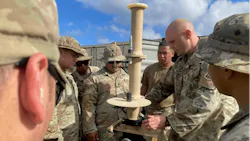
Keeping pace with the rapid spread of small uncrewed aerial systems (UASs), the Joint Interagency Task Force 401 (JIATF-401) is expanding its efforts to prepare to counter threats from those smaller drones. The Joint Counter-Small Unmanned Aircraft System University (JCU, Fort Sill, OK) is at the heart of those educational efforts. The university is developing counter-UAS curriculum for the Department of War and serves as the task force’s hub for counter-drone education and technology.
As U.S. Army Brigadier General Matt Ross, the task force director, noted, “Unmanned systems are a defining threat of our time. Drones are prolific, inexpensive, evolving quickly and increasingly accessible to nonstate actors and individuals.” The university uses a “train-the-trainer” educational model to educate instructors on how to better inform troops about counter-UAS skills.
JCU instructors were recently deployed to Guam to provide counter-UAS training to Task Force Talon and Guam National Guard Security Forces (see image above). As Ross explained, “Our mission is to ensure every warfighter has the skills to defend their post, wherever that may be. We must recognize that the homeland extends beyond the continental United States; defending Guam is defending the homeland.”
JCU director, Army Lt. Col. John Peterson, offered that instructors are adapting curriculum to reflect emerging threats and operational lessons learned: “Whether it's in a classroom at Fort Sill or on an airfield in Guam, our job is to support JIATF-401's priorities. We are improving joint force training to ensure our service members have the skills they need to defend every inch of the homeland.”
Learn more about counter-UAS technologies

About the Author
Jack Browne
Technical Contributor
Jack Browne, Technical Contributor, has worked in technical publishing for over 30 years. He managed the content and production of three technical journals while at the American Institute of Physics, including Medical Physics and the Journal of Vacuum Science & Technology. He has been a Publisher and Editor for Penton Media, started the firm’s Wireless Symposium & Exhibition trade show in 1993, and currently serves as Technical Contributor for that company's Microwaves & RF magazine. Browne, who holds a BS in Mathematics from City College of New York and BA degrees in English and Philosophy from Fordham University, is a member of the IEEE.