Thanks to DARPA, U.S. Army Black Hawk Chopper Flies Autonomously
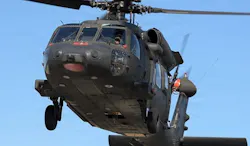
The U.S. Army’s H-60Mx Black Hawk helicopter is now available for piloted or autonomous flights. The advancement comes after a decade of research into autonomous flight by the Defense Advanced Research Projects Agency's (DARPA) Aircrew Labor In-Cockpit Automation System (ALIAS) program.
The goal of the autonomous capability is to reduce the complexity of flying the helicopter while boosting its safety for pilots and passengers, especially for critical missions. Advanced technology enables rotary and fixed-wing aircraft to be flown with or without humans on board.
The Black Hawk’s autonomy system (see image above) can manage many flight functions from takeoffs to landings. Missions can be performed by the aircraft on its own or with a remote crew supervising actions from a ground station.
The autonomous capability is available through an optional ALIAS vehicle kit that includes the aircraft’s mission manager. It's assisted by a software development kit (SDK) that allows third-party software and new sensor technologies to be integrated into an aircraft for flexible autonomous control. A key part of installing an upgrade is replacing an aircraft’s traditional mechanical flight controls with a fly-by-wire electronic system, which allows automation.
U.S. Army test pilots and engineers will evaluate the ALIAS hardware and software in the coming months for its stability and flexibility under ground control. The H-60Mx Black Hawk is the main testbed for the Army's Strategic Autonomy Flight Enabler (SAFE) program, which seeks to develop an autonomy kit that's scalable and can be universally applied across a wide range of aircraft.
Learn more about autonomous vehicles


About the Author
Jack Browne
Technical Contributor
Jack Browne, Technical Contributor, has worked in technical publishing for over 30 years. He managed the content and production of three technical journals while at the American Institute of Physics, including Medical Physics and the Journal of Vacuum Science & Technology. He has been a Publisher and Editor for Penton Media, started the firm’s Wireless Symposium & Exhibition trade show in 1993, and currently serves as Technical Contributor for that company's Microwaves & RF magazine. Browne, who holds a BS in Mathematics from City College of New York and BA degrees in English and Philosophy from Fordham University, is a member of the IEEE.