Accelerate Antenna Design for Metal-Heavy Devices with GPU-Powered Simulation
What you'll learn:
- GPU-accelerated electromagnetic simulation dramatically shortens antenna design and validation time.
- Multi-GPU solvers enable full-system analysis of antennas in complex, metal-rich environments.
- Faster simulation empowers engineers to optimize placement, efficiency, and overall RF performance.

Designing antennas for electrically large, metal-heavy products such as refrigerators and other smart appliances, vehicles, industrial equipment, and medical devices is harder than it looks. This article uses a refrigerator example to illustrate how GPU-powered simulation is transforming design workflows across all of these domains. The challenge is not only technical but also commercial, with rapidly growing markets placing increasing pressure on design cycles.
The RF Challenge for Antennas in Large Metal Enclosures
The demand for reliable connectivity is only accelerating. The smart-home appliances market alone is projected to grow from about $34 billion in 2024 to over $80 billion by 2034,1 while billions of Wi-Fi devices ship each year.2 Similar growth is seen in automotive connectivity, industrial IoT,3 and connected healthcare.
Meeting this demand is difficult because embedding antennas in large conductive structures introduces complex RF challenges. A Wi-Fi antenna may be only a few centimeters long, but once placed inside a product enclosure, its performance can change dramatically.
In a refrigerator, it must operate inside a steel structure nearly two meters tall. Those metal panels scatter, reflect, and absorb signals, reshaping the antenna’s radiation pattern. In cars, body panels can shadow embedded antennas. Industrial IoT modules may be detuned by metal control cabinets. Even medical housings could distort patterns in ways that compromise reliability.
A design that looks efficient on the bench can behave very differently once integrated into these environments. Common pitfalls include placing the antenna too close to internal brackets, routing cables in ways that inadvertently detune the radiator, or overlooking how nearby ground planes and plastics couple into the antenna.
>>Download the PDF of this article, and check out the TechXchange for similarly themed articles and videos


Capturing these effects requires full-system electromagnetic simulation, not just antenna-only design, and that comes at a cost. Wideband sweeps across 2.4 to 7 GHz with far-field monitors can easily consume many hours or even days of CPU time, slowing down design cycles and limiting how many placement options engineers are able to explore. This bottleneck is why accelerated methods are becoming so critical.
From Software Shortcuts to GPU-Accelerated Antenna Design
Most electromagnetic solvers provide techniques to trim runtime. Dassault Systèmes’ CST Studio Suite, for example, offers hybrid workflows that split a problem into a finely modeled “source” (the antenna) and a coarser “platform” (the enclosure; Fig. 1). Such workflows save memory and time, but for wideband problems — whether in a refrigerator, an automotive body, or an industrial cabinet — it’s still not enough.
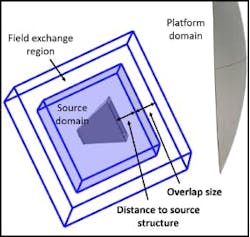
This is where hardware acceleration comes into play. Modern solvers can harness graphics processing units (GPUs) to parallelize field updates across thousands of cores. CST Studio Suite’s 2025 GPU guide documents support single and multi-GPU configurations, up to 16 per host, with transmission-line matrix (TLM) and finite-integration technique (FIT) time-domain solvers scaling particularly well.4 The result is a dramatic shift: What once required an overnight run can now be done in minutes.
Refrigerator Case Study: Shrinking 11 Hours to 24 Minutes
Consider the example of a standard refrigerator model: 1.8 m tall, 0.9 m wide, 0.7 m deep, with a Taoglas FXP830 dual-band flex antenna mounted behind the front panel (Fig. 2). It’s a realistic choice given that appliance control electronics are typically located in that area.
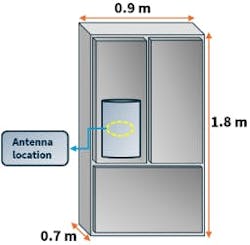
Here are some runtime comparisons from CPU only to GPU augmentations:
- CPU-only baseline: Wideband sweep (2 to 6 GHz) with 10 far-field monitors → 11 hours, 10 minutes.
- With 1x GPU: Runtime fell to 4 hours, 42 minutes.
- With 4x GPUs: For a narrower frequency sweep (2 to 3 GHz) and a single far-field monitor, the simulation completed in 24 minutes (Fig. 3).
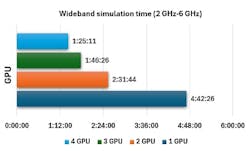
By adding first one and then four GPUs to a CPU-only baseline, a full-day job is reduced to one that could be run during a design meeting. Engineers can explore multiple placements, orientations, and keep-out distances in a single day, rather than spreading tests across a week.
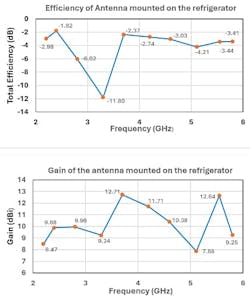
The simulations also underlined why these results are so important. The refrigerator’s metal body made the radiation pattern more directional than free space (Fig. 4), boosting gain in certain lobes but creating nulls elsewhere.
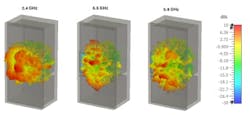
Efficiency changed significantly depending on the antenna’s distance to metal surfaces and how it was coupled to nearby ground (Fig. 5). GPU acceleration made it practical to map these sensitivities in detail.
The Benefits of Faster Antenna Simulations
The commercial implications of faster antenna simulation are hard to overstate. In consumer appliances, the most immediate gain is time-to-market: A delayed launch can mean missing an entire selling season, so the ability to evaluate a dozen antenna placements in a single day rather than a week is a powerful advantage.
The same pressure exists in the automotive market, where program timelines are tight, as well as in industrial and medical equipment, where downtime or redesign delays can be costly. Cost and sustainability benefits flow naturally. Every avoided prototype saves materials, reduces test-lab energy, and frees engineers from repetitive hardware iterations. All of these savings matter as manufacturers work toward tighter carbon-reduction goals.
There’s also a clear technology roadmap imperative. Wi-Fi 6E is already present in some appliances, and Wi-Fi 7 is now arriving in 2025-26 client devices. That requires validation not only at 2.4 GHz and 5 GHz, but also, for next-generation Wi-Fi, at 6 to 7 GHz. The Wi-Fi module market, valued at over $41 billion in 2024, is projected to expand steadily across the decade,5 underscoring just how central connectivity has become.
Across all these sectors — appliances, automotive platforms, industrial IoT gateways, and healthcare devices — designs must now be validated against evolving compliance requirements. For example, because FCC and ETSI masks at 6 GHz are stricter than at 2.4 GHz, validating placement across all bands is now critical.
Finally, expectations for device interoperability are tightening. The Matter 1.4.2 release in August 2025 improved reliability and security across ecosystems,6 raising the bar for performance. Consumers will expect appliances to “just work” regardless of platform; automotive users demand seamless in-vehicle connectivity; factories rely on equipment that communicates reliably; and hospitals need devices that integrate without interference.
Accelerated simulation ensures weak spots in antenna integration can be identified and corrected before they become compliance failures or customer complaints.
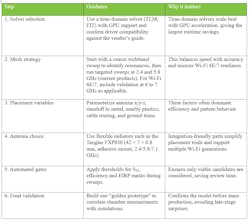
So how can engineers put these lessons into practice? The table outlines the practical steps that take a project from solver choice to final validation.
The Competitive Edge of GPU-Powered Design
Embedding antennas in metal-heavy, electrically large enclosures has traditionally been a slow and uncertain process. GPU acceleration is changing that, turning electromagnetic simulation from an overnight bottleneck into a resource that engineers can use continuously, guiding design choices in near real time.
The implications reach far beyond faster runtimes. Shorter design loops mean fewer prototypes, lower costs, and more sustainable workflows. Just as importantly, accelerated simulation helps teams stay aligned with technology roadmaps, meet compliance requirements, and deliver products that interoperate seamlessly across ecosystems.
As connectivity becomes a baseline expectation across sectors, the ability to iterate rapidly and de-risk designs early is no longer optional. It’s the new standard for competitive engineering.
References
1. Precedence Research, Smart Home Appliances Market Size and Forecast 2024-2034, 2024.
2. RCR Wireless News, “Wi-Fi Alliance: 4.1 billion Wi-Fi devices shipped in 2024,” citing Wi-Fi Alliance data, 2025.
3. IoT Analytics, State of IoT 2024: Number of Connected Devices, 2024.
4. Dassault Systèmes, CST Studio Suite GPU Computing Guide, 2025 edition.
5. Global Market Insights, Wi-Fi Module Market Size, Share & Trends Analysis Report, August 2025.
6. Connectivity Standards Alliance (CSA), Matter 1.4.2 Release Notes, August 2025.
>>Download the PDF of this article, and check out the TechXchange for similarly themed articles and videos
About the Author
 Baha Badran
Baha Badran
Global Head of Engineering, Taoglas
Baha Badran has over 20 years of experience in RF, antenna design and product development across thousands of projects. He leads a strong team of 60 world-leading engineers at Taoglas.
Baha joined Vertu/Nokia as an Antenna Engineer in 2007, working on antenna design and development for luxury mobile phones. He later advanced to the role of Senior Antenna Design Engineer, leading antenna development for various Vertu products. In 2015, he joined EDMI Limited as an RF Engineer, before transitioning to EDMI Europe Limited in 2016 as the Lead Hardware Engineer. Since 2017, he’s been working at Taoglas, starting as a Senior Antenna Design Engineer and progressing to the role of Engineering Manager (EMEA) and then Global Antenna Technology Director. Currently, he serves as the Global Head of Engineering at Taoglas.
Baha Badran holds a Bachelor of Engineering (B.Eng.) degree in Electrical, Electronics, and Communications Engineering from An-Najah National University, which he completed from 2000 to 2005. Subsequently, he pursued a Master's degree in Personal Mobile and Satellite Communications from the University of Bradford from 2005 to 2006.