16-Bit Oscilloscope Captures Sensitive, Low-Amplitude Signals
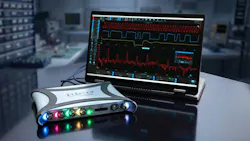
Delivering precision where it's needed and speed when it matters, Pico Technology's latest PicoScope 5000E Series oscilloscopes are compact, USB-C oscilloscopes that measure sensitive, low-amplitude signals. The scopes can move quickly between analog, digital, and mixed-signal debugging, providing true 16-bit resolution with bandwidths up to 200 MHz, sample rates of 2.5 GSPS, and 1-GS capture memory.
The PicoScope 5000E Plus Series models add a switchable 8-bit high-speed mode with bandwidths up to 500 MHz, a sampling rate of 5 GSPS, and 2 GS of deep memory in one portable instrument. It functions as an oscilloscope, FFT spectrum analyzer, 200-MSPS 14-bit AWG, function generator, frequency counter, protocol analyzer, and logic analyzer (on MSO models).
Features include an industry-leading noise floor below 22 µV RMS and greater than –73 dB THD, a less-than-22-µV RMS noise floor, and better than –73 dB of THD for measuring low-amplitude signals.
The devices can interface directly with the PicoScope 5000E Series using the company's latest multi-series API and write custom applications using C, C#, C++, Python, MATLAB, or LabVIEW. For debug and validation, the PicoScope 7 series includes more than 40 serial protocol decoders, advanced math channels, automated measurements (including power analysis), DeepMeasure for multi-capture analysis, measurement and mask limit testing, and Actions for code-free test automation.
Related Links:
About the Author
 Alix Paultre
Alix Paultre
Editor-at-Large, Microwaves & RF
Alix is Editor-at-Large for Microwaves & RF.
An Army veteran, Alix Paultre was a signals intelligence soldier on the East/West German border in the early ‘80s, and eventually wound up helping launch and run a publication on consumer electronics for the U.S. military stationed in Europe. Alix first began in this industry in 1998 at Electronic Products magazine, and since then has worked for a variety of publications, most recently as Editor-in-Chief of Power Systems Design.
Alix currently lives in Wiesbaden, Germany.