Testing Challenges in Non-Terrestrial Networks and Future Wireless Systems

5G non-terrestrial networks (NTNs) extend cellular connectivity through satellites and high-altitude platform stations. Released in 3GPP Release 17, NTN specifications enable standard smartphones to connect directly to satellites, addressing a critical gap: While terrestrial 5G reaches over 80% of the world's population, it covers less than 40% of Earth's landmass.
The technical challenges differ fundamentally from terrestrial deployments. Propagation delays reach 540 ms for geostationary satellites and 25 to 50 ms for low-Earth-orbit (LEO) constellations, dwarfing the sub-millisecond timing typical in terrestrial networks. Doppler shifts from fast-moving satellites reach ±50 to 100 kHz at S-band frequencies. Figure 1 shows how the round-trip time (RTT) is calculated, influenced by various parameters.
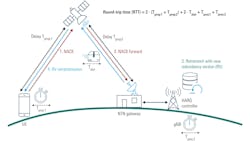
These characteristics forced significant architectural modifications. Hybrid automatic repeat request (HARQ) processes had to be reconsidered: For GEO satellites, RTT exceeds practical acknowledgment limits, leading to HARQ-disabled modes or increased process counts from 16 to 32. Timing advance values extended dramatically, with mandatory GNSS positioning for all NTN devices enabling UE-specific corrections.
Current NTN deployments operate primarily in FR1 spectrum, specifically in S-band and L-band (n255, n256, n254). Typical channel bandwidths are limited to 10 to 30 MHz due to power constraints and spectrum coordination challenges.
Real-world deployments accelerated between the years 2024 and 2025, with SpaceX's Starlink Direct-to-Cell service launching SMS capabilities with T-Mobile, AST SpaceMobile demonstrating 5G broadband from space to unmodified smartphones, and multiple IoT-NTN services going commercial using 3GPP-standardized connectivity.
Testing Complexity in NTN Scenarios
Validating NTN equipment presents unique measurement challenges. Satellite access nodes must handle time-variant propagation delays, differential delays across large beam footprints, and continuously changing frequency offsets. These are impairments that terrestrial equipment rarely ever encounters.
Consequently, test setups must emulate dynamic conditions accurately: channel emulators modeling geometric relationships between moving satellites, beam patterns sweeping Earth's surface, and three-dimensional orbital velocity vectors. Component testing requires characterization under conditions outside terrestrial specifications: extreme timing offsets, rapid frequency variations, and power control optimized for ~190- to 210-dB path loss.
The verification of phased-array antennas, critical for both ground stations and airborne platforms, requires phase-coherent multichannel measurements. Traditional approaches involve multiple synchronized instruments, complex cabling arrangements, and careful calibration procedures. Each additional connection point introduces potential phase errors and amplitude imbalances that can obscure the actual device performance.
The 6G Vision: Addressing 5G Limitations
While 5G NTN deployment continues, 6G research addresses fundamental limitations. Expected around 2030, 6G aims to tackle the challenges that 5G couldn’t fully solve.
Coverage and capacity remain primary concerns. Current satellite direct-to-handset services achieve around 20 Mb/s, serving basic connectivity but far below terrestrial performance. 6G aims for dramatic terrestrial improvements targeting peak rates approaching 1 Tb/s, while also advancing NTN capabilities through higher frequency bands, regenerative satellite payloads, and AI-optimized beam management.
Energy efficiency emerges as critical. 5G networks consume significant power, especially in dense mmWave deployments. 6G focuses on sustainability from the ground up through AI-driven resource allocation and intelligent sleep modes.
Most significantly, 6G embraces AI as native infrastructure rather than an enhancement. This manifests in three stages: AI optimizing operations (neural receivers, resource allocation, beamforming, etc.), networks designed for AI workloads (semantic communication, federated learning), and AI as a billable service (on-demand inference, intent-driven communication).
For NTN specifically, 6G evolution includes regenerative satellite payloads with full base-station functionality on board. Combined with inter-satellite links, this enables direct routing between satellites rather than requiring each transmission to bounce through ground stations. Such a constellation-level architecture reduces the number of hops for certain traffic patterns and improves overall network flexibility and resilience.
Beyond 5G Research: The Parameter Challenge
The 5G to 6G transition presents a fundamental challenge: testing technologies without established standards. Researchers must experiment with parameters far outside current specifications.
Consider modulation formats. Though 5G standardizes up to 256-QAM, researchers investigate 4096-QAM and even 16384-QAM for specialized scenarios. These extreme modulation orders demand unprecedented signal-to-noise ratios and introduce measurement challenges that push traditional test equipment to its limits.
The question isn’t whether these orders will appear in consumer devices (they likely will not), but rather how they influence the design of adaptive modulation schemes and AI-driven signal processing.
Channel bandwidths provide another example. 5G specifies bandwidths up to 100 MHz in FR1 and 400 MHz in FR2. Early 6G research requires testing signals spanning multiple gigahertz continuously, exploring wideband channel effects not addressed with current standards. Researchers need the ability to generate, transmit, and analyze these ultrawideband signals to understand propagation characteristics and develop appropriate channel models. In initial 6G deployments, these wideband scenarios seem unlikely.
Frequency domain spectrum shaping (FDSS) represents a promising technique for improving power efficiency in uplink-constrained scenarios. These are particularly relevant for IoT and satellite communications.
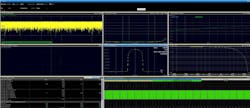
By applying frequency-domain filtering to DFT-spread-OFDM waveforms, FDSS reduces peak-to-average power ratio and out-of-band emissions. This allows transmitters to operate closer to saturation, improving link budgets by 4 to 5 dB, which is critical when every decibel determines whether a connection succeeds or fails over satellite distances. Figure 2 shows a demodulation with all relevant parameters of an FDSS signal.
Digital post-distortion (DPoD) offers another avenue for improving system efficiency. Traditional digital predistortion (DPD) in transmitters compensates for power amplifier nonlinearities but adds complexity and power consumption to user devices. DPoD shifts this compensation to the receiver, typically at the base station where processing power is abundant.
Early implementations, including testbeds developed jointly by Nokia Bell Labs and Rohde & Schwarz, show substantial coverage improvements for 6G uplink scenarios. However, validating these AI-based receivers requires the ability to precisely characterize both linear and nonlinear impairments across multiple signal paths simultaneously.
Neural receivers and custom modulation formats push testing requirements even further. Rather than using predetermined constellations like QPSK or QAM, AI/ML-trained systems optimize constellation shapes jointly with receiver processing, taking channel characteristics into account. These "learned constellations" may eventually enable pilotless communication, dramatically reducing signaling overhead.
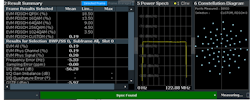
Testing such systems requires equipment that can handle arbitrary constellation definitions and accurately measure performance metrics like error vector magnitude, even when the modulation format itself is unconventional. Figure 3 shows the implementation of a probabilistic distribution as recently discussed in 3GPP.
The Multichannel Testing Imperative
These research challenges share a requirement: sophisticated multichannel analysis. Beamforming systems for 6G require precise phase and amplitude relationships across dozens or hundreds of antenna elements, demanding phase-coherent measurements across multiple ports.
Traditional approaches create complexity, which include multiple synchronized spectrum analyzers, precision reference clocks, and elaborate matched cable networks. Each connection introduces uncertainty. Calibration becomes time-consuming and must be repeated frequently. Individual analyzer noise floors limit the detection of weak signals or small impairments.
For amplifier characterization, fundamental to any wireless system and particularly critical for satellite payloads, engineers need to observe both input and output signals simultaneously across wide bandwidths. This reveals nonlinear behavior, spectral regrowth, AM-AM and AM-PM conversion characteristics, and memory effects. Traditional setups require separate signal generators, analyzers, and careful synchronization.
The challenge intensifies when researchers investigate cross-layer effects or mutual interference between different signals at different frequencies. Understanding how a high-power radar signal might impact co-located 5G equipment requires simultaneous capture and analysis of both signals, potentially separated by gigahertz in frequency but sharing the same physical space and interference environment.
Architectural Solutions: The Multiport Approach
Recent analyzer architecture advances address these challenges through fundamental redesign. Multiport architectures with phase-coherent internal signal paths enable scenarios that previously required multiple instruments.
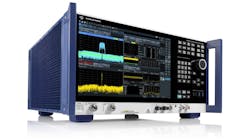
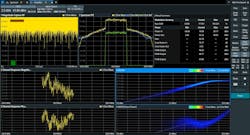
For example, Rohde & Schwarz’s FSWX signal and spectrum analyzer has an innovative dual-port architecture (Fig. 4). Two independent receive paths, each with 4-GHz analysis bandwidth up to 44 GHz, operate simultaneously and phase-coherently. This configuration directly enables several critical measurement scenarios.
For amplifier or frequency converter characterization, connecting input and output signals to separate ports allows for instantaneous comparison (Fig. 5). The analyzer captures both signals simultaneously, revealing frequency-domain characteristics like spectral regrowth and time-domain behavior like AM-AM conversion, all within a single measurement. This eliminates synchronization challenges and reduces calibration requirements.
Phased-array testing becomes dramatically simpler. The phase-coherent architecture enables direct measurement of phase relationships between antenna elements or signal paths. For beamforming research, where the relative phase between channels determines beam direction and sidelobe levels, it provides immediate validation without external synchronization hardware.
The dual-path architecture also opens the door to an innovative cross-correlation mode. A single input signal splits internally into two independent paths, each with its own local oscillator and analog-to-digital converter.
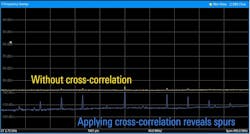
By processing these two paths together using cross-correlation algorithms, the analyzer can suppress its own noise floor by approximately 15 to 20 dB. This extends dynamic range significantly, revealing weak signals, small spurs, or subtle impairments that would otherwise hide in the instrument's inherent noise.
As Figure 6 illustrates, the cross-correlation technique of the FSWX can lower the test noise floor with only a slight increase in measurement time. The blue trace with applied cross-correlation reveals spurs hidden in the yellow trace without cross-correlation.
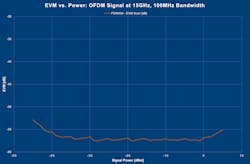
The cross-correlation capability proves particularly valuable for error-vector-magnitude (EVM) measurements at low signal powers, which are common in research scenarios where signals have undergone significant attenuation or where researchers deliberately test extreme conditions. The improved noise floor extends the usable measurement range of the EVM bathtub curve (Fig. 7), providing accurate results even when traditional analyzers struggle.
The architecture's advanced filter banks offer another advantage. Rather than relying on YIG filters, which introduce frequency-response variations and uncertainty in wideband measurements, switched filter banks across the entire operating range provide consistent preselection. This eliminates image frequency ambiguity and improves measurement accuracy, especially above 8 GHz, where traditional architectures face increasing challenges.
Enabling Beyond 5G Experimentation
These architectural capabilities directly address Beyond 5G research requirements. When investigating custom modulation formats or learned constellations, researchers need to accurately measure performance without being limited by test equipment impairments. Cross-correlation mode reduces analyzer contributions to EVM measurements, allowing focus on actual device or algorithm performance.
For DPoD research, simultaneous input/output capture across wide bandwidths reveals how receiver-side processing compensates for transmitter nonlinearities. The phase-coherent architecture ensures accurate characterization of both magnitude and phase distortions that AI-based receivers must correct.
FDSS validation requires measuring subtle spectrum-shaping effects and precisely quantifying peak-to-average power ratio improvements. Wide instantaneous bandwidth capture ensures that no transient effects are missed, while low noise floors reveal spectral detail even at reduced power levels.
Multi-antenna research scenarios benefit from the ability to simultaneously analyze multiple signal paths with guaranteed phase coherence. Whether investigating multiple-input, multiple-output (MIMO) channel estimation, spatial multiplexing techniques, or advanced beamforming algorithms, having phase-locked measurements eliminates a major source of uncertainty.
The Beyond 5G option extends standard cellular analysis capabilities to support parameters outside current specifications. Researchers can configure arbitrary channel bandwidths, custom modulation formats, and non-standard resource block configurations. This flexibility enables exploration of the parameter space that will eventually inform 6G standardization decisions.
Looking Ahead: Test Infrastructure for the Transition
The path from 5G NTN to 6G isn't a single technology leap, but rather an evolutionary process where researchers build understanding through experimentation. Test infrastructure must support both validation of current standards and exploration of future possibilities.
For NTN evolution, this means equipment capable of emulating increasingly complex scenarios: regenerative payloads with on-board processing, inter-satellite links with dynamic routing, and integrated sensing/communication where signals serve multiple purposes simultaneously. As NTN frequency bands expand to Ka-band and beyond, test equipment must maintain performance at these higher frequencies while handling wider instantaneous bandwidths.
For terrestrial 6G development, terahertz spectrum exploration requires new approaches to signal generation and analysis. Though initial 6G deployments may not utilize THz bands (predictions of widespread terahertz communication have repeatedly proven premature), research must continue to understand propagation, device physics, and channel modeling at these frequencies.
The integration of AI throughout the wireless stack creates new validation requirements. How do you verify that an AI-optimized network makes correct decisions? How do you test neural receivers against the infinite variety of possible channel conditions? How do you measure the performance of semantic communication systems where traditional metrics like bit error rate may not apply? These questions demand test approaches that blend traditional RF measurement with data science techniques.
Conclusion
The evolution beyond 5G presents testing challenges paralleling the technological advances themselves. From NTN's extreme delays and Doppler shifts, through 6G's terabit speeds and microsecond latencies, to AI-native communication systems, each advance requires corresponding measurement capability.
Modern test equipment addresses these through architectural innovation: multi-port phase-coherent designs, cross-correlation techniques, and flexible analysis frameworks. As researchers explore technologies that won't standardize for years, test infrastructure must support both current validation and future exploration.
The goal isn’t easier measurements, though simplified setups help, but making previously impossible measurements achievable. Accurate characterization of neural receivers, validation of digital post-distortion across wide bandwidths, and multi-antenna analysis with confident phase relationships let researchers focus on advancing technology rather than wrestle with test limitations.
As wireless technology evolves, the partnership between innovation and validation remains essential. The ability to test what we imagine today determines what we deploy tomorrow.
Read more articles in this special report
 cellular_dreamstime_l_73406034
About the Author
Johan Nilsson
Product Manager, Signal and Spectrum Analyzers, Rohde & Schwarz
Johan Nilsson is Product Manager for Signal and Spectrum Analyzers at Rohde & Schwarz.
Related
 Leaders Logo
Leaders relevant to this article: