How Antenna-on-Package Tech Will Unlock RF Designs Across Markets in 2026
What you'll learn:
- Antenna-on-package radar sensors will greatly reduce the complexity of RF designs.
- The benefits of AoP technology will extend into a host of application types.
- Designers gain lower signal losses, zero board-routing losses, and improved accuracy and range performance without the need for RF expertise.

Radio-frequency (RF) system design is inherently complex. Implementing a radar sensor-based design, whether for automotive, industrial, robotics, or medical applications, requires costly substrate materials, precise layout techniques, and an advanced level of RF design expertise.
Designing an extremely-high-frequency (EHF) radar sensor antenna on a printed circuit board (PCB) is even more challenging. Conventional radar sensors take up significant board area and require meticulous design to minimize losses, impedance mismatches, and environmental sensitivities while maximizing antenna performance. mmWave refers to the band from 30 to 300 GHz of the RF spectrum and is categorized by the International Telecommunication Union as an EHF technology.
How an AoP Architecture Simplifies RF Design
An antenna-on-package (AoP) architecture helps eliminate many of the design challenges by reducing the cost, complexity, and size of traditional sensor designs. As the name suggests, AoP integrates the antenna elements directly onto the package rather than the PCB (Fig. 1). Incorporating the antenna elements on the package creates a multiple-input, multiple-output (MIMO) array capable of sensing objects and people with a wide field of view (FOV) in three dimensions and under diverse environmental conditions.
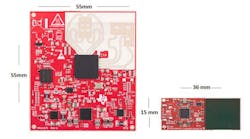
Because an AoP device helps resolve the complex design challenges of mmWave antenna design, designers no longer need to handle RF and antenna engineering in-house and can focus on building differentiated radar-enabled products without having radar design expertise.
High levels of integration place the RF front end, signal processing chain, microcontroller, interfaces, and memory within a single AoP device. By combining advanced semiconductor technologies with real-time radar sensing, signal processing, and high-performance integrated antennas, AoP-based sensors provide accurate detection along with increased resolution and power efficiency.
This level of integration also boosts processing capabilities at the sensor edge, enabling more intelligent and compact radar systems.
AoP’s Versatility Creates Greater Opportunities in RF Sectors
The band from 57 to 64 GHz (often referred to as the 60-GHz band) is the mmWave radar band with the most growth potential. The global 60-GHz market size reached $1.2 billion in 2024 and is expected to continue expanding to an estimated $3.5 billion by 2033 — an annual compound growth rate of 12.6%.
Advances in integrated system-on-package (SoP) solutions such as AoP offer a high degree of sensing accuracy and reduce design barriers for many developers. Other market drivers include the rapid adoption of AoP-based radar designs across diverse industry sectors and the convergence of AoP technologies with artificial intelligence and machine learning.
Let’s look at the benefits of AoP in several different sectors and types of end equipment.
How AoP Advances Smart Homes and Buildings
Building automation — particularly smart homes (Fig. 2) and more efficient buildings — is the biggest non-automotive application for mmWave radar, and specifically AoP technology. Almost any connected device in a home can be made smarter by integrating more accurate presence, motion, and position sensing.

Some home and building products that would benefit from radar-based AoP technology include automatic doors, locks and keypads, lights, fans, appliances, indoor air-conditioning units, thermostats, TVs, and video doorbells. Being more aware of whether someone is in a room helps connected devices be more efficient and useful.
For example, lighting systems could use radar to adjust brightness based on actual presence, reducing energy waste compared to passive infrared motion sensors, which can’t easily measure small movements.
Smart thermostats and heating, ventilation, and air-conditioning controls are able to sense activity levels, ensuring efficient heating and cooling for improved comfort and thereby potentially lowering energy costs. Security devices could also benefit from accurate intrusion detection and perimeter monitoring without capturing images, preserving user privacy.
AoP Sensors Make for Smarter Robotics
In robotics, AoP sensors for embedded gesture-controlled human-machine interfaces enable presence detection, classify hand gestures, and send the information to a processor. AoP saves space over PCB-based radar antennas because AoP-based designs can fit into small enclosures within autonomous guided vehicles, delivery robots, or small robotic arms.
The wider field of view and advanced processing contained in some AoP radar designs make it possible to incorporate environment sensing into robot systems. They also enable machines to make smarter decisions based on 3D detection of people and objects.
In Automotive Uses, AoP Sensors Deliver Versatility
To meet regulatory requirements specified by the European New Car Assessment Programme, automotive designers must use 60-GHz AoP sensors to accurately detect children and pets left inside vehicles. The very small form factor makes it possible to seamlessly integrate AoP sensors into different vehicle interior designs.
In addition, the placement of the sensors in a vehicle can detect intruders, enhance seat-belt reminders, detect driver fatigue or sleepiness, and monitor occupant conditions for enhanced comfort and airbag deployment.
The near-field sensing capabilities provided by 77-GHz AoP sensors can enable door and trunk obstacle detection. Furthermore, the sensors are able to detect parked cars and objects through entry-level blind-spot detection and comply with the functional-safety-related design requirements specified in International Organization for Standardization 26262, to Automotive Safety Integrity Level B.
AoP Sensors, AI, and the Internet of Medical Things
In healthcare applications, AoP radar devices can detect subtle changes in respiratory and heartbeat patterns, offer continuous sleeveless blood-pressure monitoring, and aid in the assessment of sleep-disordered breathing. When combined with the Internet of Medical Things and artificial intelligence, AoP radar provides noninvasive real-time monitoring of a patient’s condition (such as heart and breathing rates) and enables analysis of intricate changes in collected data.
Contactless radar is sensitive enough to monitor the cardiopulmonary activities of premature infants without harming delicate skin. AoP-based systems can offer early warnings about irregular breathing rhythms that cause blood oxygen values to drop.
Finally, for aging populations, AoP-based systems offer continuous and noninvasive remote patient monitoring. The small-form-factor devices can detect the presence of chronic diseases, measure vital signs, and capture variations in responses that predict the onset of serious conditions. Radar-based smart sensors offer solutions for detecting falls and other events related to body movements.
AoP Radar Devices Free Up Design Resources
The Internet of Things is connecting and opening the door to even smarter devices. Radar sensors enable product developers to meet demand, while the need for accurate sensor data will lead to more applications for AoP radar devices. By eliminating the need to design a PCB-based antenna, reducing the size of designs, and increasing time-to-market, AoP can help expand the use of radar while allowing for system innovations elsewhere.
The design simplicity translates into lower signal losses, zero board-routing losses, and improved accuracy and range performance without the need for RF expertise. Meanwhile, the extremely small form factor will help unlock a range of new and more useful products with a small sensor footprint.
About the Author
 Robert Tolbert
Robert Tolbert
Product Marketing Manager, mmWave Radar Sensors, Texas Instruments
Robert Tolbert has more than 20 years of semiconductor industry experience working on analog interface, processor, and radar solutions. He currently serves as product marketing manager at Texas Instruments (Dallas) for the low-power radar product line.