Ultrasonic Chipsets Boost Precision for Automotive Apps
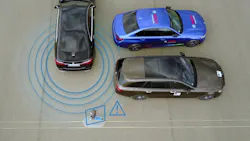
Improved signal quality enables Bosch's new ultrasonic chips to make more accurate AI-based decisions in parking and driving situations.
April 29, 2026
2 min read

Empowering applications like intelligent parking assistants, Bosch released its latest ultrasonic chipsets for close-range perception in vehicles. The TB193 and TB293 chipsets allow for more precise detection of objects such as parked vehicles or curbs, delivering higher-accuracy distance measurements.

These solutions process the raw signals directly from the ultrasonic sensors, providing a significantly larger and more detailed dataset. This raw data contains more detail than pre-processed information, making it possible for AI-based parking assistants to better assess the surroundings. In addition to objects, road conditions like wet or varying surfaces can also be detected for things like smarter braking decisions.

The chipsets capture and process ultrasonic data directly at the source, with one chip controlling and processing the data while the other chip captures the sensor signals. Together, they deliver the information that AI-based parking or brake-assistance systems need, along with the necessary data-transmission speed and bandwidth to handle and transport these large volumes of raw data in real-time.

Versatile Automotive Sensor Interface

The company is also introducing the VASI bus (Versatile Automotive Sensor Interface), an open interface for vehicle manufacturers that provides greater flexibility in choosing sensor suppliers. The TB293 sensor chip is installed directly at the ultrasonic transducer, capturing raw signals without intermediate steps. The TB193 controller chip centrally coordinates multiple sensor chips and prepares the collected data for further processing.
 
The end result is that vehicle manufacturers can scale the number of sensors depending on vehicle class and desired functional scope.
 
Features include a high data rate of 1.16 Mb/s, enabling real-time processing of large amounts of data for next-generation smart assistance systems. Raw data transfer opens up possibilities from high-quality data fusion to advanced AI algorithms, and the chipsets use up to 50% less energy than legacy solutions.
 
The chips require fewer peripheral components and fewer pins, while the VASI bus transmits both data and power, reducing cabling, simplifying wiring, and saving significant weight. The chipset’s temperature rating of up to 150°C (approx. 300°F) ensures reliable operation even under demanding conditions.

Related links:

More New Products

Vector Photonics
Vector Photonics and Fraunhofer UK prove real-world practicality of PCSEL technology, enabling secure, long-distance, fast communications.
Vector Photonics and Fraunhofer UK demonstrated free-space optical transmission using a PCSEL, enabling secure, long-distance, fast communications.
ID 148403090 | Abstract Communication © Akesin | Dreamstime.com
cloud_dreamstime_l_148403090
NeoCortec's NeoGW software and centralized Network Management web application ushers in seamless cloud integration and wireless mesh-network management.

About the Author

Alix Paultre

Editor-at-Large, Microwaves & RF

Alix is Editor-at-Large for Microwaves & RF

An Army veteran, Alix Paultre was a signals intelligence soldier on the East/West German border in the early ‘80s, and eventually wound up helping launch and run a publication on consumer electronics for the U.S. military stationed in Europe. Alix first began in this industry in 1998 at Electronic Products magazine, and since then has worked for a variety of publications, most recently as Editor-in-Chief of Power Systems Design.

Alix currently lives in Wiesbaden, Germany.