Laser Terminals Bring Wide Bandwidths to Low Orbits
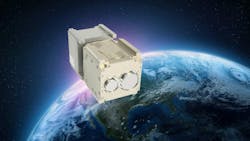
The ATLAS-1 laser communications terminal from Astrolight, known for secure wide-bandwidth maritime and terrestrial communications, will soon be evaluated for its space-to-Earth capabilities. It's about to be tested onboard two low-Earth-orbit (LEO) satellites as part of two separate Transporter-16 missions from SpaceX.
A pair of Astrolight’s Greek clients is coordinating the missions: the National Kapodistrian University of Athens (Athens, Greece) and the Aristotle University of Thessaloniki in Greece.
According to Laurynas Mačiulis, CEO of Astrolight, “These in-orbit missions are a big milestone for the global small satellite industry. He added, “Smallsat operators have long faced the issue of having to sacrifice data traffic due to the limitations of radio spectrum and antenna size. Because ATLAS-1 (see image above) is laser-based, it provides high data rates, but with equipment that is smaller and more affordable than many other solutions on the market.”
Mačiulis remarked that the number of satellites in orbit was steadily growing, calling for action in providing reliable communications link solutions: “With orbit becoming more crowded, operators relying on traditional radio-frequency links are facing growing spectrum licensing limitations and increasing exposure to unintentional interference. Integrating laser communication into space systems is one of the best ways to deliver secure, high-throughput connectivity while reducing dependence on scarce RF spectrum and its constraints.”
Backed by the European Space Agency (ESA), the two missions are part of Greece’s national small-satellite initiative. The orbiting stations will demonstrate Gb/s downlink speeds to optical ground stations (OGS) in Greece. They will experiment with various elevation angles, weather conditions, and illumination environments. Astrolight upgraded the OGS equipment with an 808-nm laser beacon and C-band optical receiver to ensure positive results.
Learn more about laser communications



About the Author
Jack Browne
Technical Contributor
Jack Browne, Technical Contributor, has worked in technical publishing for over 30 years. He managed the content and production of three technical journals while at the American Institute of Physics, including Medical Physics and the Journal of Vacuum Science & Technology. He has been a Publisher and Editor for Penton Media, started the firm’s Wireless Symposium & Exhibition trade show in 1993, and currently serves as Technical Contributor for that company's Microwaves & RF magazine. Browne, who holds a BS in Mathematics from City College of New York and BA degrees in English and Philosophy from Fordham University, is a member of the IEEE.