Leading European nations are showing their interest in on-orbit servicing technologies through the European Robotic Orbital Support Services Space Consortium (EROSS SC) project. Funded by the European Union (EU) and coordinated by Thales Alenia Space, the EROSS SC demonstrates the strength of collaborating countries when faced with engineering challenges beyond the limits of Earth’s orbit. In addition to Thales in France, EROSS includes the DLR German Aerospace Center (Stuttgart, Germany) and Sener Aerospace and Defence (Spain).
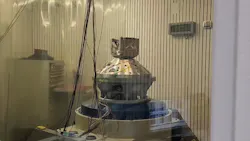
The EROSS consortium united European industry in design reviews of satellites and the next-generation technologies needed to keep them in orbit. It continues to integrate contributions from multiple nations and to enter the critical design phase of the program. Of the consortium, Bertrand Denis, vice-president Observation, Science, and Exploration at Thales Alenia Space in France, notes his company’s/country’s place: “In a context where European space sovereignty matters more than ever, Thales Alenia Space is proud to coordinate the EROSS consortium.” Thales recently completed high-vibration characterization of satellites in its laboratories (see figure).
Denis added: “Technologies used for on-orbit servicing developed in the framework of current and upcoming phases of EROSS leverage our long experience in space exploration and will strengthen European resilience thus contributing to Europe’s space sovereignty.” Speaking for the DLR German Aerospace Center, Professor Dr. Alin Albu-Schaeffer, director of the Institute of Robotics and Mechatronics, explained: “EROSS is a game-changer for orbital services, and it puts European space innovation very visibly on the map.” He added: “With this mission, we are not just demonstrating what’s possible; we are proving that Europe is leading the way in the future of robotic space operations.”