Antenna Design Must Evolve to Meet 6G NTN Needs
What you'll learn:
- Why 6G antennas must be intelligent, reconfigurable, and capable of operating from sub-GHz to sub-THz frequencies.
- How technologies such as RIS, metamaterials, new materials, and AI-driven optimization are enabling next-generation antenna architectures.
- What design challenges must be addressed by engineers to support dense networks, native NTN connectivity, and integrated sensing and communication?

The 5G rollout is still some way from completion, but industry attention is already turning to the future. 6G networks may appear to be aspirational at this stage, but development in the underlying technologies is accelerating, and commercial deployment of this next-generation wireless technology is expected to begin around 2030.
In this article, we discuss the challenges that 6G will present to radio access technologies, particularly the antenna, and look at some of the work being done around the globe to address them.
Antenna Demands in the 6G Era
The 6G vision centers on a cyber-physical continuum in which the digital and physical worlds are tightly linked. Rather than treating communication, sensing, computing, and positioning as separate capabilities, 6G brings them together in what’s described as an “Intelligent Network of Everything.”
This requires RF systems that not only transport data, but also cooperate with sensing, localization, and computing functions at a far deeper architectural level than today. AI will play a major role here, enabling near-instant data transfer, sub-millisecond latency, and data rates approaching terabits per second. Coverage will also extend well beyond terrestrial networks, with non-terrestrial networks (NTNs) expected to be a native part of the 6G architecture.
The range of services under discussion includes holographic communication, brain–computer interfaces, real-time digital twins, immersive extended reality, autonomous mobility, and large-scale machine-type communications (Fig. 1).

This vision is still several years away from reality, but global standardization bodies such as the ITU and 3GPP are already defining initial 6G networking requirements. In laboratories and academic institutions around the globe, R&D on the technologies required to enable 6G networks is advancing rapidly, and early field trials are anticipated by the end of the current decade.
Along with advances in semiconductors, signal processing, and AI, the realization of the 6G vision depends heavily on the evolution of the antenna. More than a transmission and reception device, the antenna is key to the efficiency, reliability, and scalability of next-generation networks.
The Antenna Challenges Ahead
The seamless interaction between the network and physical world, which is fundamental to the 6G vision, will be enabled by multiple arrays of embedded sensors and actuators, connected to each other and to the network.
The network gateways that will handle the massive volume of data flowing to and from these devices will require exceptional levels of resilience and reliability. At the same time, they will push the limits of energy and spectral efficiency across both new and existing frequency ranges. These requirements highlight the challenges facing the design and topologies of the antennas of the future (Fig. 2).
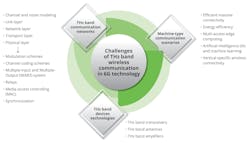
6G will be deployed across a wide range of frequency bands. These include current frequencies in the sub-1-GHz range, 3.5- to 6-GHz mid-band range, and millimeter-wave (mmWave) range, as well as new frequencies in the 7- to 15-GHz centimeter-wave (cmWave) range, and the 90- to 300-GHz sub-THz range. 6G antennas must therefore support multi-band operation across this broad frequency range.
The ongoing trend toward higher frequencies, with shrinking propagation distances and increasing signal attenuations, will drive higher network densities. As network infrastructures become denser, antennas will need to be more tightly integrated with RF front ends and baseband circuitry, driving greater miniaturization and co-design across the entire module. And with more access points operating in smaller cells, interference management and signal coordination will be critical to maintaining stability and efficiency.
These challenges are expected to move current massive-MIMO (multiple-input, multiple-output) arrays toward more synchronized distributed MIMO architectures, with antennas distributed across wider spaces to deliver the required performance.
Meeting the 6G challenge will require continual improvement in the mechanical and electrical radiation performance of the antenna, alongside energy savings and diminishing form factors. Future antennas will have to be highly flexible, operating across a wide range of frequencies and power levels, since there will be no room in future devices for multiple antennas.
Ongoing R&D work is focusing on the concept of the intelligent antenna system — highly reconfigurable, compact, and software-defined devices — that will form the backbone of the future 6G radio ecosystem.
Emerging Research Directions and Technology Enablers
The antennas used in future 6G devices, whether in base stations, vehicles, or wearables, will not just transmit and receive signals; they will sense, adapt, and collaborate. These adaptive antennas will use real-time feedback from network conditions and user mobility to optimize beam patterns automatically, minimizing interference while maximizing link quality.
To achieve this, current research is converging around several key enabling technologies that are expected to redefine antenna performance in the 6G era, including:
- Reconfigurable intelligent surfaces (RIS) are large, programmable surfaces made up of thousands of sub-wavelength elements that can manipulate electromagnetic waves in real-time. By adjusting phase, amplitude, and polarization, RIS panels can actively shape the radio environment, redirecting, focusing, or scattering signals to improve coverage and spectral efficiency. Rather than relying solely on base stations, networks will be able to use RIS as controllable reflectors, effectively turning walls, buildings, or even vehicles into part of the network infrastructure.
- Metamaterials provide unprecedented control over electromagnetic behavior through engineered substructures. These materials enable ultra-compact, wideband, and steerable antennas that can operate efficiently at THz frequencies. Researchers are demonstrating tunable metasurface antennas capable of switching beam patterns and frequencies electronically, eliminating the need for bulky mechanical steering systems.
- Antenna arrays that use advanced semiconductor switching, varactors, or microelectromechanical systems (MEMS) are emerging as a practical approach to agility. Electronically configurable antennas can dynamically adjust beam direction, gain, and impedance based on real-time network feedback. Such adaptability will be vital for maintaining robust links across highly variable propagation conditions, such as in mobile or dense urban environments.
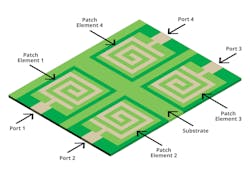
- New substrates such as low-loss ceramics, flexible polymers, and graphene-based conductors (Fig. 3) are under investigation for THz-band operation. Their lower dielectric loss and higher thermal conductivity support efficient operation even as antenna geometries shrink. Meanwhile, additive manufacturing and 3D printing are enabling cost-effective prototyping of complex, high-performance structures.
The Road Ahead: From Research to Realization
Although 6G promises transformative capabilities, it’s still very much at the pre-commercial research stage, with key technologies under evaluation. Industry experts expect early trials toward the end of the decade, but full-scale rollout will depend on global standardization and ecosystem readiness.
As the mobile sector continues to grapple with the challenges of monetizing and fully deploying 5G, 6G research represents both an opportunity and a test. It must deliver meaningful new capabilities while ensuring commercial and environmental sustainability. Many of the technologies explored today, including reconfigurable surfaces, adaptive arrays, and AI-driven control, will evolve through intermediate milestones such as “5G-Advanced” and early 6G prototypes, making sure that there’s a smoother transition between generations.
The consensus among industry researchers is clear: Antennas will be at the heart of 6G innovation. Their ability to dynamically shape, sense, and control the wireless environment will define how 6G delivers on its promise of a seamlessly connected, intelligent world.
Read more articles in this special report
 cellular_dreamstime_l_73406034
About the Author
 Baha Badran
Baha Badran
Global Head of Engineering, Taoglas
Baha Badran has over 20 years of experience in RF, antenna design and product development across thousands of projects. He leads a strong team of 60 world-leading engineers at Taoglas.
Baha joined Vertu/Nokia as an Antenna Engineer in 2007, working on antenna design and development for luxury mobile phones. He later advanced to the role of Senior Antenna Design Engineer, leading antenna development for various Vertu products. In 2015, he joined EDMI Limited as an RF Engineer, before transitioning to EDMI Europe Limited in 2016 as the Lead Hardware Engineer. Since 2017, he’s been working at Taoglas, starting as a Senior Antenna Design Engineer and progressing to the role of Engineering Manager (EMEA) and then Global Antenna Technology Director. Currently, he serves as the Global Head of Engineering at Taoglas.
Baha Badran holds a Bachelor of Engineering (B.Eng.) degree in Electrical, Electronics, and Communications Engineering from An-Najah National University, which he completed from 2000 to 2005. Subsequently, he pursued a Master's degree in Personal Mobile and Satellite Communications from the University of Bradford from 2005 to 2006.
Related
 Leaders Logo
Leaders relevant to this article: