Safeguarding the Spectrum from Threats with Software-Defined Radios
What you'll learn:
- No longer restricted to lab and prototyping work, SDRs can handle extremely rugged field applications.
- EW and SIGINT applications include electronic support, attack, and protection.
- On the civil-defense side, SDRs can serve in signal fingerprinting, interference detection, or coexistence testing.

The electromagnetic spectrum (EMS) is more congested than ever. From airports and WiMAX centers to military and commercial satellites, unmanned aircraft, GPS jammers, and shipboard radar systems, the number of active RF signals and systems continues to grow. Whether it's a drone hobbyist or a coordinated swarm from a near-peer threat, detecting and neutralizing these activities has become increasingly difficult.
The challenge lies not only in the sheer number of signals, but also in their diversity: They range among pulsed; continuous-wave; wideband; and narrowband, low-power, intra-pulse signals, as well as their wide frequency range counterparts.
Identifying, analyzing, and protecting against these signals in real-time, and across diverse environments, requires a solution that’s both agile and resilient. This is where software-defined radios (SDRs) are stepping in. With reconfigurable hardware and flexible software, SDRs offer the adaptability needed to keep pace with evolving EMS threats.
From the Lab to the Field: COTS and Ruggedized SDRs
For years, engineers across defense, research, and communications sectors have used commercial off-the-shelf (COTS) SDRs for prototyping and testing. A common example is the NI USRP platform, widely used for its accessibility, affordability, and broad software support. COTS SDRs have powered passive radar systems, SIGINT testbeds, MIMO experiments, and more. Figure 1 illustrates the EMS threat matrix.
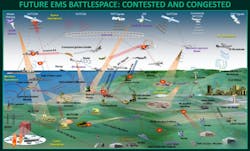
Now, with ruggedized variants available, SDRs are moving even farther beyond the lab. These hardened systems can withstand the environmental extremes required for field deployment, from vehicle-mounted units to fixed installations.
Meanwhile, many defense programs are adopting modular open standards such as OpenVPX. These systems enable greater scalability and interoperability, in line with the Department of Defense's Modular Open Systems Approach (MOSA). While OpenVPX offers benefits in flexibility and system integration, it comes with tradeoffs — higher cost, longer lead times, and more complex development.
Drone Detection and Deterrence
Drone threats are no longer hypothetical. Extending beyond hobbyist use or controlled military operations, drones have rapidly evolved into a disruptive force across both the civilian and defense domains. From battlefield reconnaissance to airport shutdowns and incursions at critical infrastructure, their accessibility and versatility make them difficult to predict, and even harder to counter. Understanding how and where these systems operate is essential to developing effective detection and mitigation strategies.
Commercial drones typically operate in the 2.4- and 5.8-GHz ISM bands. More advanced or military-grade systems may use frequencies extending into the C-band, X-band, or even Ku-band, depending on their communications protocols and mission requirements. This wide spectral range, combined with the speed and unpredictability of drone activity, demands sensing solutions that are both agile and adaptable.
Download the PDF of this article, and check out the TechXchange for similar articles and videos

Higher-performance SDRs with scalable software are well-suited to track signals across these frequencies. Hardware that supports up to 6 GHz and up to 160 MHz of baseband bandwidth with a wide dynamic range and real-time processing capabilities are ideal as they support fast detection, classification, and response. The ability to survive in mobile or pole-mounted (outdoor) environments is also very beneficial.
The deployment environments in these applications may include fixed installations, mobile (land, sea, or air) platforms, or rugged transport cases. While outdoor enclosures are commonly used, they often provide limited protection from dust, temperature extremes, and moisture. Over time, even sealed boxes collect dust and contaminants that can impact reliability. Transport cases can add a lot of size and weight, and they typically need to be opened or otherwise customized to prevent exposure to the elements.
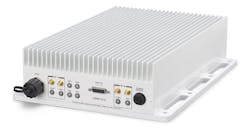
Therefore, for more demanding environments, fanless, conduction-cooled enclosures offer a more resilient alternative, minimizing moving parts and supporting wider thermal tolerances. Figure 2 shows a ruggedized RX310 qualified for a fully sealed outdoor operation across extended temperature ranges.
Drones represent one of the more visible and immediate spectrum challenges, but they’re just one piece of a much larger picture. Across the defense landscape, control of the electromagnetic spectrum is a foundational requirement that powers everything from tactical communications to high-end electronic warfare systems.
EMS Control in Electronic Warfare and SIGINT
Nowhere is EMS superiority more critical than in defense. Modern radar, navigation, targeting, and communication systems all rely on clean access to the spectrum. This includes a wide range of SIGINT, electronic warfare (EW), and Communications, Command, Control, Computers, Cyber-defense, Intelligence, Reconnaissance, and Surveillance (C5ISR) applications. These depend on control over the EMS to function effectively in contested environments.
We can parse these elements into three core areas:
- Electronic support (ES) enables situational awareness through signal interception, direction finding, and characterization.
- Electronic attack (EA) includes jamming or spoofing to disrupt enemy communications or radar.
- Electronic protection (EP) ensures resilience against similar attacks, safeguarding friendly systems.
Part of situational awareness is the ability to determine the direction of the attack (angular search, direction of arrival) and identifying the aspects of the signal such as the frequency, modular/waveform bandwidth, and strength over time. A rugged SDR can support all three. It can receive and process RF signals for analysis, then transmit custom jamming waveforms including noise, deception, or delayed retransmissions as part of an EA mission.
Conversely, software layers could be used to test and validate anti-jam waveforms or techniques. As demonstrated in the example in Figure 2, the ability to scan wide RF bands (70 MHz to 6 GHz) for emissions, with capabilities for angle of arrival (AoA) or time-difference of arrival (TDOA) detection and response, is critical.
Utilizing similar approaches with higher-performance processors such as UltraScale FPGAs, one may achieve greater bandwidth and channel density for real-time signal processing. And there’s the possibility of incorporating higher instantaneous bandwidth and advanced use cases like beamforming or multichannel direction finding.
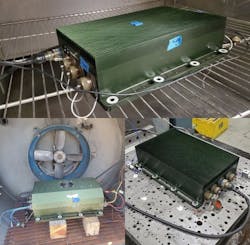
A key requirement for these types of applications is a reasonably low-cost COTS option to be utilized on aircraft of other extreme environments. Figure 3 shows a rugged RX410 going through MIL qualification testing to meet the shock/vibration, EMC, thermal, and other environmental concerns for these types of applications. With a MIL-grade fan and internal MIL-704F power and EMI filtering, we may design an enclosure to meet the MIL requirements for extreme requirements. This includes temperature ranges from −40 to +70°C.
Protecting Civil and Commercial EMS Access
While military spectrum operations often take the spotlight, commercial and civil EMS management is still critical. It’s essential to establish clean access to the spectrum from 5G and WiMAX deployments to radar coexistence and air-traffic control.
Here, too, SDRs play an important role. They can capture full traffic bursts such as radar pulses and push-to-talk transmissions as well as identify unique spectral or modulation signatures. Digital signal processing (DSP) or machine-learning algorithms can be applied for fingerprinting, interference detection, or coexistence testing.
Size, weight, and power (SWaP) considerations are important not only in defense applications, but all types of applications requiring compact size and power efficiency. Many edge deployments like pole-mount, backpack/human-carry, and rooftop installations have such limitations, calling for smaller and more efficient options.
In weather-exposed environments, an indoor enclosure may not provide adequate protection over time. They’re often opened for maintenance, exposing them to dust, sand, and the elements. Unless fitted with temperature controls, many outdoor enclosures will not help against the heat and cold of the seasons in many climates.
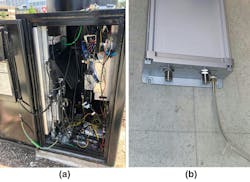
Thus, having the ability to meet wider temperature ranges is another key requirement for an SDR. Figure 4a shows ruggedized RN310 and B210 systems sealed in conduction-cooled outdoor housings to protect against extreme elements and temperatures. Figure 4b shows an IP67-rated unit being dunked in water, illustrating protective sealing.
The EMS Evolution
As threats across the electromagnetic spectrum evolve, the need for agile, rugged, and capable SDR-based systems has never been greater. Whether for drone detection, EW and SIGINT operations, or protecting commercial spectrum assets, ruggedized COTS solutions can provide a readily available option that’s cost-effective, proven, and ready to run.
As these applications need to survive in extreme environments, the ability to provide a MIL-rugged SDR that can survive shock/vibration, EMI exposure, dust/sand/moisture, and extended temperature ranges is paramount.
Download the PDF of this article, and check out the TechXchange for similar articles and videos
About the Author
Justin Moll
Vice President of Sales & Marketing, Pixus Technologies
Kelsey Ryon
ADG Technical Marketer, Emerson NI
Kelsey Ryon is the ADG Technical Marketer at Emerson NI.