Helmet Display Meets Demanding Naval Needs
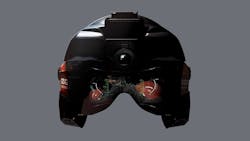
Agile aircraft like the F/A-18E/F Super Hornet and EA-18G Growler call for enhanced control capabilities, and along those lines, the Zero-G Helmet Mounted Display System+ (HMDS+) may equip pilots with many advantages.
Developed according to U.S. Navy requirements by Collins Elbit Vision Systems (CEVS) — a joint venture between Elbit Systems of America and Collins Aerospace, an RTX business — the HMDS+ helmet (see image above) was intended to meet or exceed the requirements of the Improved Joint Helmet-Mounted Cueing System (IJHMCS).
The sixth-generation helmet-mounted display system provides a high-resolution view of the most advanced and fast-moving battlespaces. The Zero-G HMDS+ can help organize mission data, sensor video, and weapons systems information while serving as a primary flight instrument.
Captain Joseph Kamara, PMA-202 organization program manager for Naval Aircrew Systems, explained the importance of the Zero-G HMDS+ to the modern battlefield, “Aircrew health and safety is our number one priority. The Zero-G being integrated through our IJHMCS program promises to relieve aircrew of neck and back strain and greatly improve ejection safety.”
Kamara admitted, “We are excited to be at the leading edge of safety and technology, and this important milestone is a critical step toward deploying this capability for our F/A-18 and EA-18 aircrew.”
Luke Savoie, Elbit America’s president and CEO and a CEVS board member, explained, “Zero-G is providing sensor fusion at the edge. This system is critical technology, while remaining lightweight. As fighter aircraft level-up, the HMDs of those systems need to as well. Zero-G provides unmatched head-up, sixth-generation battle management capabilities.”
Collins Aerospace’s Daniel Karl, CEVS co-general manager, added, “When our team began working on the Zero-G HMDS+, our goal was to provide aircrew with the safest, most advanced helmet system on the market. This milestone confirms our helmet is ready for the next phase of development and brings us one step closer to delivering this advanced capability to naval aviators.”
In the next development stage, the helmet will undergo airworthiness testing and full integration with aircraft avionics and mission systems, eventually to be fielded for more than 750 aircraft starting in 2027.
Learn more about MIL vision systems
 Denewsjuly6 1 Promo
 dejan231_promo

About the Author
Jack Browne
Technical Contributor
Jack Browne, Technical Contributor, has worked in technical publishing for over 30 years. He managed the content and production of three technical journals while at the American Institute of Physics, including Medical Physics and the Journal of Vacuum Science & Technology. He has been a Publisher and Editor for Penton Media, started the firm’s Wireless Symposium & Exhibition trade show in 1993, and currently serves as Technical Contributor for that company's Microwaves & RF magazine. Browne, who holds a BS in Mathematics from City College of New York and BA degrees in English and Philosophy from Fordham University, is a member of the IEEE.