855B Phase Coherence
Purpose
This application note reports the measured channel-to-channel and unit-to-unit phase stability of the Model 855Bmulti-channel Signal Generator.
Introduction
Early frequency synthesizers were not necessarilycontrolled by a single crystal standard. Adequate frequencystability was obtained using several internal crystaloscillators that contributed to the overall frequency stabilityof the output. These devices were considered non-coherent.As applied to frequency synthesizers, phase coherencedescribes the relation of the frequency standard to theoutput frequency. If the output frequency accuratelyreproduces the relative frequency stability of the standard,the device is considered coherent. Despite this definition,the assumption that all contemporary systems that use asingle standard (external or internal) are coherent isincorrect. Many systems that utilize fractional-N or binaryDDS fine-resolution synthesizers are not truly phasecoherent; rather they have specified small but finitereference-to-output errors.
What is of particular interest is the phase stability observedover a long period of time between two independent signalsources that are phase locked to the same external (usually10 MHz) reference.
This application note shows the phase coherence of theModel 855B multi-output Signal Generator, whose channelsshare one reference and whose modules can besynchronized to each other and to an external reference.
The Model 855B is available with frequency ranges of 300kHz to 6, 12, 20, 33 or 40 GHz and up to four channels in a1U module. Each channel can be programmedindependently in frequency, phase (0 to 360 degrees in 0.1degree steps), amplitude and modulation.
Test Setups
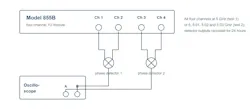
Figure 1a shows the test setup to determine the level ofphase stability (coherence) between two individual outputsof a single instrument. A phase detector and a digitaloscilloscope are used to monitor the phase stabilitybetween two RF channels over a long time interval, in thiscase approx. 24 hours. All tests were performed at 20°C ±1°C.