Vector Modulation, I/Q & Pulse Descriptor Words
Analog modulation versus vector modulation
An analog Signal Generator varies one property of the carrier at a time: amplitude for AM, frequency for FM, or phase for PM.That is enough for many tasks, and it keeps the architecture simple. It is not enough for modern digital communications or forrealistic radar and electronic warfare signals, where amplitude and phase change together in arbitrary patterns that no singleanalog parameter can describe.
Vector modulation solves this by controlling amplitude and phase simultaneously and independently. Any point in the complexplane becomes reachable, so any waveform that can be written as a sequence of amplitude and phase values can begenerated.
The I/Q representation
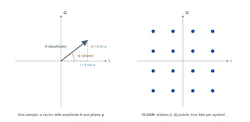
Vector modulation works in terms of two components. The in-phase component, I, is the part of the signal aligned with areference carrier. The quadrature component, Q, is the part shifted ninety degrees from it. Together I and Q define a vectorwhose length is the instantaneous amplitude and whose angle is the instantaneous phase. Steer that vector over time andyou have produced an arbitrary modulated signal.
This representation is powerful because complex schemes reduce to streams of I and Q samples. A 256-QAM constellation,an OFDM symbol, a chirped radar pulse, or a frequency-hopped waveform all become sequences of I/Q values fed to themodulator. The Model 875 carries a digital I/Q modulator fed by an internal baseband generator, so it plays custom I/Qwaveforms from memory, generates QAM from 8QAM to 4096QAM with Option IVM, adds the avionics formats DME, VOR,ILS and marker beacon with Option AVIO, and adds Gaussian noise at a set carrier-to-noise ratio with Option AWGN.
Wideband modulation and deep memory
Two properties decide how demanding a vector source can be: modulation bandwidth and memory depth. Wide modulationbandwidth lets the source reproduce signals that occupy large instantaneous spans, which matters for wideband radar,modern wireless, and realistic interference. Deep waveform memory lets it play long, non-repeating sequences withoutlooping, which matters when a short repeating pattern would betray the simulation or fail to stress the device under test.
The 875 has a 400 MHz RF modulation bandwidth, a 16-bit baseband generator at up to 500 MS/s and 512 MS of waveformmemory, and adds linear chirp, intra-pulse modulation and pulse shaping. The 875 therefore controls the modulation withineach pulse as well as its envelope.
Click here to learn more.