Understanding Phase Noise & Spectral Purity
What phase noise is
An ideal oscillator would produce a single, infinitely thin spectral line. Real sources do not. Tiny random fluctuations in thephase of the carrier spread energy into a skirt on either side of the intended frequency. That skirt is phase noise. In the timedomain it shows up as jitter. In the frequency domain it shows up as a continuous pedestal of power surrounding the carrier,and it is the measure of spectral purity that sets the floor for most measurements the source takes part in.
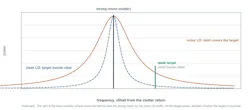
Phase noise matters because it does not stay confined to the source. It transfers, by mixing and by frequency multiplication,into every measurement the source takes part in. A receiver tested with a noisy local oscillator measures worse than it is. In aradar, reference phase noise at the Doppler offset of a slow target sets how far below the clutter return that target can still bedetected. Source phase noise adds to the measured phase noise of the device, so the source contribution has to be small atthe offsets of interest.
Reading the specification: dBc/Hz at an offset
Single sideband phase noise is quoted in dBc/Hz at a stated offset from the carrier. The unit has three parts. The "dBc" partmeans decibels relative to the carrier power. The "/Hz" part normalizes the measurement to a one hertz bandwidth, so twoinstruments measured differently can still be compared. The offset, written as 1 kHz, 20 kHz, 10 MHz and so on, tells youhow far from the carrier the measurement was taken.
A figure of -132 dBc/Hz at a 1 kHz offset means that, one kilohertz away from the carrier, the noise power in a one hertzbandwidth is 132 dB below the carrier. More negative is better. Because the offset is always part of the number, a singlephase noise figure is incomplete without its offset and carrier frequency. A source can be excellent close to the carrier andordinary far out, or the reverse, so sources are compared across a curve of offsets rather than at one point.
Close-in versus far-out
Phase noise behavior changes with offset, and different applications care about different parts of the curve. Close-in noise,roughly 10 Hz to a few kilohertz, is dominated by the reference oscillator and the loop that locks to it. This region governsslow drift, coherence between channels, and the ability to resolve closely spaced tones. Far-out noise, from tens of kilohertzto tens of megahertz, is set by the output stages and the noise floor, and it governs wideband interference and adjacentchannel behavior.
A high-quality OCXO reference and a well-designed loop push the close-in numbers down. Clean output amplification andfiltering push the far-out floor down. The two are engineered separately, which is why options such as enhanced close-inphase noise (often labeled LN or LN+) target one region without changing the other.
Why it matters: radar, communications, quantum
In radar, reciprocal mixing of local oscillator phase noise onto a strong clutter return can mask a weak moving target nearbyin frequency. Close-in phase noise directly limits the smallest Doppler shift a system can resolve, so pulse-Doppler andcoherent radars need the lowest close-in phase noise the budget allows.
Click here to learn more.