IMU Shrugs Off GNSS Outages for High-Accuracy LiDAR Mapping
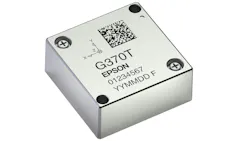
The Overview: IMU Maintains Accuracy When Satellites Disappear
Epson Microdevice’s G370 inertial measurement unit (IMU) for LiDAR applications suffers little loss of accuracy during GNSS interruptions, whatever the cause. It maintains point-cloud fidelity through very low drift, strong bias stability, and low inertial noise.
Who Needs It & Why: LiDAR Mapping in High-Risk Conditions
Even high-resolution LiDAR systems can produce distorted or misaligned point clouds when navigation errors accumulate. Heading drift during GNSS loss often manifests as warped geometry, duplicated edge “ghosting,” or long-range distortion issues that drive rework, extended post-processing, and costly re-scans.
LiDAR measurements are heavily relied upon in industries like mobile mapping, surveying, construction, mining, and autonomous platforms. It's often real-world operating conditions, and not sensor resolution in and of itself, that limits measurement accuracy. That means things like urban canyons, tunnels, trees, bridges, or structures are the limiters of mapping accuracy and consistency.
Under the Hood: Higher Inertial Stability, Lower Drift
To combat navigation errors, Epson’s G370 IMU improves inertial stability and reduces drift, allowing LiDAR platforms to preserve scan alignment and accuracy for longer periods when satellite positioning is degraded or unavailable. The device addresses these challenges with very low drift, particularly for a MEMS-based sensor, strong bias stability, and low inertial noise. It also provides a 50% reduction in angle random walk (ARW), which influences gyroscopes and causes orientation errors that accumulate over time.
As a result, the G370 IMU delivers accurate, consistent trajectories during GNSS dropouts, dynamic motion, and feature-poor operation. At typical mapping ranges, the G370 limits lateral blur to the millimeter scale during seconds of inertial-only operation, preserving sharper edges and cleaner geometry.
The G370’s low inertial noise and stable rate sensing translate directly into measurable point-cloud improvements — at typical mapping ranges, attitude noise contributes only millimeter-level lateral blur over seconds of inertial-only operation. This helps LiDAR systems produce crisper edges, thinner surfaces, and more consistent scan alignment across vehicle-mounted, UAV, UGV, and backpack platforms. At the same time, users gain reduced filter tuning effort and post-processing time.
IMU Supports SLAM in Feature-Poor Environments
In environments with limited visual or geometric features such as tunnels, highways, warehouses, or agricultural fields, simultaneous localization and mapping (SLAM) performance relies heavily on inertial propagation. In these scenarios, IMU drift and heading stability often determine whether mapping solutions remain accurate or diverge.
Epson’s G370 IMU helps improve propagated pose quality during low-constraint segments, strengthening SLAM robustness and improving mapping consistency across real-world deployments.
The G370 is in full production and available now for integration into LiDAR mapping, mobile scanning, and navigation systems.
Related links:



About the Author

David Maliniak
Executive Editor, Microwaves & RF
I am Executive Editor of Microwaves & RF, an all-digital publication that broadly covers all aspects of wireless communications. More particularly, we're keeping a close eye on technologies in the consumer-oriented 5G, 6G, IoT, M2M, and V2X markets, in which much of the wireless market's growth will occur in this decade and beyond. I work with a great team of editors to provide engineers, developers, and technical managers with interesting and useful articles and videos on a regular basis. Check out our free newsletters to see the latest content.
You can send press releases for new products for possible coverage on the website. I am also interested in receiving contributed articles for publishing on our website. Use our contributor's packet, in which you'll find an article template and lots more useful information on how to properly prepare content for us, and send to me along with a signed release form.
About me:
In his long career in the B2B electronics-industry media, David Maliniak has held editorial roles as both generalist and specialist. As Components Editor and, later, as Editor in Chief of EE Product News, David gained breadth of experience in covering the industry at large. In serving as EDA/Test and Measurement Technology Editor at Electronic Design, he developed deep insight into those complex areas of technology. Most recently, David worked in technical marketing communications at Teledyne LeCroy, leaving to rejoin the EOEM B2B publishing world in January 2020. David earned a B.A. in journalism at New York University.